Friday, October 2, 2020

When Rose Can Be Picked


I repeat, two scans from 'Roman de la Rose' manuscript 'Francais 25526' from 1325-1350. The picture on the left and right are related.  Picture on top: harvesting grain (left) and threshing grain (right). Than we must read picture on bottom as: harvest fertility (left) and of the right:
  • ... separate the edible part from the straw
  • ... cut the crap (not literally)
  • ... choose a fertile man among the potential fathers
  • ... stop messing around and let's make love
  • ... when the rose can finally be picked

In 1900 this book in old French was translated into English by Ellis (based on ‘Orleans ed. 1878’). He considered the last part of this book as too “hot” (my word) that he dare not to translate it. His words: “giving reasonable offence”.


Last week I read Horgan’s (1994) translation based on ‘Felix Lecoy edition 1965-1970’. She dared to translate the last chapter ‘The conquest of the rose’ into English too. What was considered too hot for the 1900 eyes? Quotes:

"If she commanded, he obeyed; under no circumstances would he refuse to gratify her every desire. He could lie with his sweatheart, and she would neither resist nor make complaint. They played such games of love that she became pregnant."

(…) "He may pluck it [the gift of the rose] while the two of us are alone here. I should have received him long ago, for I can see that his love is true."

(…) "There to fulfil my pilgrimage. I had laboriously brought with me my scrip and my staff that was so stiff and strong that it needed no ferrule when going on journeys."

(…) "However, I continued my assault until I noticed a narrow passage through which I thought I could pass, but first I had to break down the barrier. This tiny, narrow pathway that I have mentioned."

(…) "Nothing, however, could have prevented me from sliding my staff all the way in. I did so without delay."

(...) "For I was the first to do so, and the place was not yet in the habit of collecting tolls."

(…) "Therefore I forced my way into it, for it was the only entrance, in order duly to pluck the rose-bud."

(…) "I can tell you that at last, when I had shaken the bud, I scattered a little seed there. This was when I touched the inside of the rose-bud and explorered all its little leaves, for I longed, and it seemed good to me, to probe its very depths (…) with the result that all the rose-bud swelled and expanded."

(…) "I plucked with joy the flower from the fair and leafy rose-bush. And so I won my bright red rose. Then it was day and I awoke."


"And my staff that was so stiff and strong," how does that sound in old French? Quote from Ellis (appendix line 22142ff; bold by JD):

Ge qui l'en rens mercis cent mile,
Tantost comme bons pelerins,
Hatis, fervens et enterins
De cuer, comme fins amoreus,
Après cest otroi savoreus,
Vers l'archiere acueil mon voiage
l'or fornir mon pelerinage ;
Et port o moi par grant effort
Escherpe et bordon grant et fort,
Tel qu'il n'a mestier de ferrer
Por jornoier, ne por errer.
L'escherpe est de bonne feture,
D'une pel souple sans cousture ;

These lines in translation by Horgan (around line 21312ff):

"I thanked him a hundred thousand times, and promptly made my way, like the good pilgrim I was, with heart as ardent, ferfent, and loyal as any true lover, towards the aperture, there to fulfil my pilgrimage. I had laboriously brought with me my scrip and my staff that was so stiff and strong that it needed no ferrule when going on journeys. The script was well made of a supple, seamless skin.”

P.S. Translation by Ellis digital: here.

Friday, September 25, 2020

A Visual Image of New Science

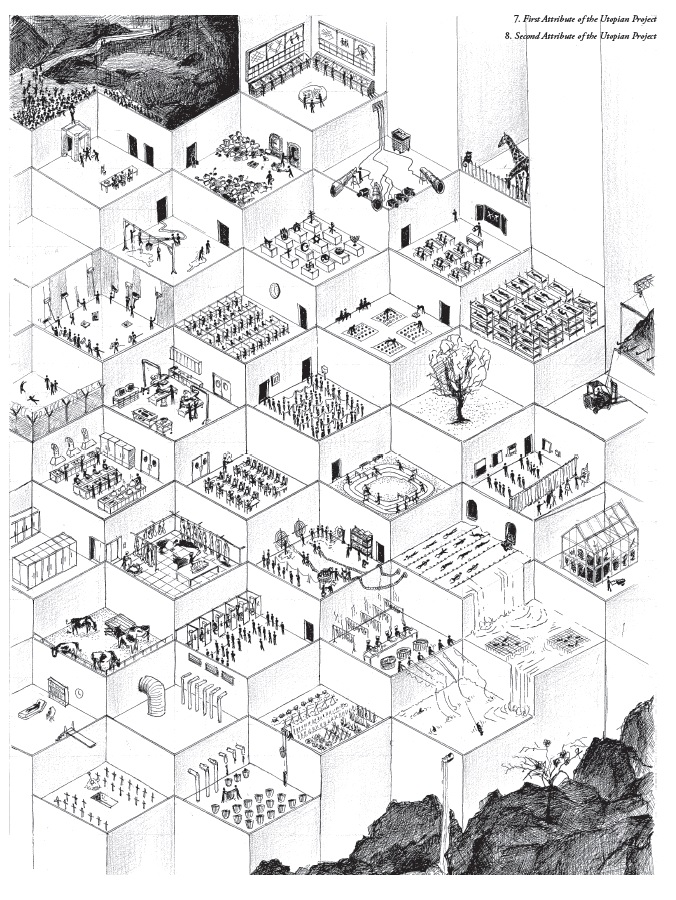
In 2016 Carlijn Kingman wrote her master thesis ‘The Institute of Utopianism’ on the faculty ‘Architecture and The Built Environment’ in Delft, The Netherlands. Thesis: here.

Her conclusion:
“This elaboration into the rotten structure of the waver ivory tower of science, the science paradigm of positive rationalism, has led to a proposal for a new paradigm shift: the science of complexity.
Finally, in order to communicate and elaborate on newly born outlines of this new paradigm of science, I have translated its goals and elements into a metaphorical program of requirements: cartography chambers, the agora for debate, stairs and bridges to connect it all, and more. With this metaphorical program of requirements, together with the manifesto which describes a set of guidelines to create valuable architectural utopias for tomorrow, I will set off to create my own utopian design: the institute of utopianism, a new of science to stimulate the emerge of plural utopianism, a utopia which aims to become its own parent.”


A proposal for a paradigm shift into a science of complexity. Metaphorical requirements: cartography chambers, the agora for debate, stairs and bridges to connect it all, and more. A call for plural utopianism. Her four utopian project attributes:


Resulting in this 'Vertical Section of New Science':

Who did she consult for her utopia's? She has taken into consideration the following 29 utopias (I have added the division into centuries):

[-5th century]

  • Plato (427 BC - 347 BC). The Republic.

[5th century]

  • Augustine, Saint (426). The City of God.

[16th century]

  • More, Sir Thomas (1516). Utopia.
  • Bruegel den Elder, Pieter (1567). Luilekkerland.

[17th century]

  • Andreae, Johann Valentin (1619). Christianopolis.
  • Bacon, Francis (1627). The New Atlantis.
  • Campanella, Tomasso (1637). The City of the Sun.
 [18th century]
  •  Mercier, Louis Sebastien (1772). Memoirs of the Year 2500.
  • Ledoux, Claude Nicolas (1775). The town of Chaux, the royal saltworks.
  • Spence, Thomas (1795). Description of Spensonia.

[19th century]

  • Fourier, Charles Francois Marie (1822). Traite de l’Association domestique agricole.
  • Buckingham, James Silk (1848). National Evils and Practical Remedies.
  • Bellamy, Edward (1897). Looking Backward.
  • Hertzka, Theodor (1888). Freeland: A Social Anticipation.
  • Morris, William (1890). News from Nowhere.

[20th century]

  • Wells, H. G. (1905). A Modern Utopia.
  • Corbusier (1924). Ville Radieuse.
  • Lang, Fritz (1926) Metropolis
  • Hilberseimer, Ludwig (1927). Groszstadt Architektur.
  • Huxley, Aldous (1931). Brave New World.
  • Zamyatin, Yevgeny (1937). We.
  • Orwell, G. (1949). Nineteen Eighty-Four.
  • Friedman, Yona (1958). Mobile Architecture.
  • Situationists International (1958). Situationist City.
  • Nieuwenhuys, Constant (1959). New Babylon.
  • Archizoom (1970). No-Stop City.
  • Le Guin, Ursula K. (1974). The Dispossessed.
  • Koolhaas, Rem (1978). Delirious New York: A Retrospective Manifesto for Manhattan.
  • The Wachowski Brothers (1999). The Matrix.

What strikes me is that her writers are mainly dating from the 19th and 20th century and that all of them are from Europe (including North-America). My visualisation of the numbers:


Are there no writters of utopias in Africa, China, Oceania and South-America? Is it possible that science, positive rationalism and utopias have the same root constraint? Are we solving the right constraints by embracing more complexity and plurality?

Monday, September 14, 2020

Strange Fruit

Mostly we think of kings and knights in castles when we think about the Middle Ages (between 500-1500 in Western Europe). A society that was deeply religious and where woman were treated with courtly love. No sex? But the real medieval world was less black and white and more naughty than we might presuppose. 

What to think about the phallus tree in the ‘fertility fresco’ (Massa Marittima, Italy circa 1265)?


What to think about the phalli harvested as fruit from trees in ‘Roman de la Rose’ manuscript Francais 25526 (Paris, France 1325-1350)?


What to think about this pilgrim badge displaying three phalli bearing a crowned vulva in a procession (Brugge, Belgium around 1375-1450)?


According to Reiss, these badges - many of them have been found - were sold at religious places and at the end of the pilgrimage thrown into the water. Reiss: "Thus, by buying a phallic badge at a shrine, a pilgrim might have been purchasing a particularly potent symbol of fertility. By depositing it in water (another symbol of fertility), the pilgrim would be magnifying the power of the badge.”

These humorous, sexual objects were certainly not purely religious. Sexual body-parts must be viewed as having multiple layers of meaning: religious, fertility/ sex, humor/ satire/ rude and protection (Reiss page 167 and 176).

What to think about watercolor 'Beauty Revealed' from 1828? Sarah Goodridge sent a selfportrait of her breasts to Daniel Webster when he was a new widower and it was likely intended for his eyes alone.


P.S. Fertility fresco pictures: here.

P.P.S. Whole ‘Roman de la Rose’ manuscript 'Francais 25526' can be found: here. Scans with phalli: 106v, 135v and 160r. It was great fun for me to scroll through a complete Roman de la Rose manuscript. Wondering about the colors, the images and the creativity. Mark, that the picture on the left and right are related to each other just like the harvesting and threshing of grain. Scan 131r:

In that case the picture on top of the three Roman de la Rose pics must be: harvest fertility and ... cut the crap (not literally) ... choose a fertile man among the potential fathers ... stop messing around and let's make love ... when the rose can finally be picked.

P.P.P.S. Reiss, Ben. "Pious Phalluses and Holy Vulvas: The religious Importance of Some Sexual Body-Part Badges in Late-Medieval Europe (1200-1550)." Peregrinations: Journal of Medieval Art and Architecture 6, 1 (2017): 151-176. Copy: here.

Friday, September 11, 2020

Eirene

Look how beautiful. A Fayum portret from a young woman with the name Eirene from 40 AD (around). The text under her head is in demotic and reads: "Eirene, daughter of Silvanus, her mother is Senpnoutis. May her soul live before Osiris-Sokar, the great god, lord of Abydos". Almost 2,000 years old!

 
P.S. Source wiki commons: here. 
P.P.S. More details. For Borg it is: "the most beautiful sight in the world" (German: der zierlichste Anblick der Welt).

Sunday, September 6, 2020

Sociological Equivalent Splitting Atom

 Wade Davis in 'Rolling Stone' August 6, 2020 (here):

"More than any other country, the United States in the post-war [after 1945] era lionized the individual at the expense of community and family. It was the sociological equivalent of splitting the atom. What was gained in terms of mobility and personal freedom came at the expense of common purpose."

Of splitting the atom! Individual gain first, second and third and the rest ... externalities (my words). Let me repeat, according to me we should learn more about externalities. At universities, at schools, in offices, in factories, in the military, at churches and at home.

P.S. I wrote before on 'History of Dealing with Externalities' (10-2018).

P.P.S. Source picture: here.

Thursday, September 3, 2020

Bless You Darling

 After World War 2 Balasa wrote to Paddy on January 27th, 1946:

"I forget nothing of the past, and all you gave is, and will always be a great treasure - I hope that you think of me in the same way. Do write. Love."

P.S. I wrote about this love couple before in  'Among Lemon Groves' (3-2020) and 'Living History' (3-2020).

Thursday, August 27, 2020

Everything

August Willemsen writes in his book 'De Taal als Bril' (1987) on page 24:

"De vertaler (...) schrijft andermans werk. Dat mag misschien niet creatief heten, het stelt hem wel de merkwaardige eis dat hij moet weten wat de schrijver weet.
Hij moet vertrouwd zijn met het land van de schrijver en, uiteraard, met de taal daarvan. Maar ook met de regio of de stad van de schrijver en de taalkundige eigenaardigheden dáárvan. Met de tijd van de schrijver, de geschiedenis van diens land, de literatuur daarvan en de speciale literaire traditie waarin hij eventueel zijn plaats heeft. Met andere talen, literaturen, kunsten, kortom: met ‘alles’ waaraan de schrijver, direct of indirect, refereert. De vertaler moet weten wat de schrijver gelezen heeft, moet op de hoogte zijn van diens literaire invloeden en voorkeuren, en eigenlijk van zijn hele leven. Hij moet weten wat er óver de schrijver geschreven is. En dat alles bij iedere andere schrijver opnieuw.”

Translated (by Google Translate):

"The translator (...) writes other people's work. That may not be called creative, but it does make him a curious requirement to know what the writer knows.
He must be familiar with the author's country and, of course, with its language. But also with the region or city of the writer and its linguistic idiosyncrasies. With the writer's time, the history of his country, its literature and the special literary tradition in which he may have his place. With other languages, literatures, arts, in short: with 'everything' to which the writer refers, directly or indirectly. The translator must know what the writer has read, must be aware of his literary influences and preferences, and in fact his whole life. He must know what has been written about the writer. And all that with every other writer again." 

P.S. Painting is from Carel Willink, 'Landscape with overturned statue' (1942).

Saturday, July 25, 2020

Alternative


Alternatives for 'Show Me Your Library and I'll Tell You Who You Are':

* What are your favorite color(s)?
* What countries don't you want to visit?
* How does your first lover describe you?
* Your biggest regret in life?
* The first three smells that come to mind?
* Tell me about your mother in law?
* What is the next language you want to master?
* The one book you never want to read?
* Imagine you could reproduce yourself with anyones DNA. Who is number 1 on your list?
* Favorite poem?
* Favorite painting, watercolor or other piece of art?
* Favorite quote?
* ... - there must be more

Friday, July 24, 2020

Decrypting

Enjoy your summer holiday. What are your plans for this summer?

I'll be offline for the next four weeks. My project for this summer: decrypt a couple of 17th century Dutch  encrypted VOC/ WIC manuscripts. After the decryption, translate them into Dutch and English.