Saturday, November 21, 2015

The Ultimate CAS

Did you know that the exhaust of the engine is so hot that it melts concrete?


A couple of weeks ago I finished Bob Marston's book 'Harrier Boys. Volume One. Cold War Through the Falklands 1969-1990' (2015). The Harrier is one of my most favourite military fighters. Why? Because it doesn't need a long and clean runway to take-off into the air and to land on the ground. It can fly vertically - and backwards! The technical term for this type of airplane is V/STOL. It's in my opinion the ultimate close air support (CAS) fighter for armies with lust for 'blitzkrieg'.


Unbeaten! The Harrier is one (of few) of the aircraft that have engaged in significant air combat but never been shot down in air to air combat (losses 0). They shot down themselves 21 aircraft in the air. Three were shot down by ground fire. Source: here.

Bob Marston was one of the Harrier boys. He wrote down his memories and of the other boys that flew in these aircraft too. He also documented a few stories of the supporting staff.

Two new insights for me from this book.
1. Falkland Islands. The Harrier force was well prepared for a war in Europe. An out-of-NATO operation in the South Atlantic was not envisaged. In fact, it had been ruled out in successive Defence White Papers. For the Falklands the British had to start from scratch, at very short notice and with small margins for protection.
2. Others fly Harriers too? A little conversation between an English and American crewchief. The British had 58 airmen for 8 Harriers and flew a "hundred" sorties a day. The Americans had 600 airmen for 12 Phantoms and flew six sorties a day. "He didn't openly call me a liar, but disbelief was written all over his face. (...) He then clearly saw that one of my aircraft had flown 12 sorties a day, and the other one 13. Talk about impressed, he asked how we managed with so few airmen to an aircraft, so we explained the aircraft trades to him. He couldn't believe that one rigger did the whole aircraft, undercarriage, wheels, tyres and brakes."

This picture may be not very sensational but this is what a training field site looks like. With drive-through hides and connected pad and strip. A strip that can stand the heat of the engine exhaust.

Wednesday, November 4, 2015

I Just Want To Walk Down

I just want to walk down your road
I just want to dance slow

Of all I’ve known
All I’ve seen
All I dream
You’re ...

Wednesday, October 28, 2015

Why Ancient Egypt?

The ancient Greeks, and through them the ancient Romans held the ancient Egyptians in high regard as a font of ancient wisdom. The roots of our Greek-Roman civilization of today owe more to ancient Egypt than is commonly realized. 

What are those roots? Answer via book 'The Illustrated Dictionary of Ancient Egypt' from Ian Shaw and Paul Nicholson (2008):
  • AKHENATEN. For the first time 'There is only 1 God' is born. Freud claims - not in the above mentioned book - that Akhenaten is the Moses of the Bible.
  • AMMUT. The creature of the netherworld that eats the hearts of those whose evil deeds (read: the weight of the 'heart' doesn't match 'maat') made them unfit to proceed into the afterlife.
  • BOOK OF THE DEATH. 42 negative confessions. Summarized they resemble the 'Ten Commandments' of the Bible.
  • ETHICS/ MAAT. Right is live in Maat ('truth' or 'harmony'). Wrong is live in Isfet ('chaos', 'lies' or 'violence').
  • FIELD OF REEDS (AARU). Heavenly paradise. Ideal hunting and fishing ground in eternal reed fields.
  • HIEROGLYPHS. Language
  • SCIENCE:
    • CALENDAR. A year has 12 months and three seasons with four 30-day months. Each month comprised three 10-day weeks. Day and night have each twelve hours.
    • MATHEMATICS AND NUMBERS. Value for Pi of 3.16. Calculation of the height or angles of pyramids. Moving of large weights of stone.
    • MEDICINE. "Egyptian medicine was a mixture of magical and religious spells with remedies based on keen observation of patients."
    • PRIESTS. They were the 'servants of God' and held a number of different offices. One of them were the 'hour priests' who  were responsible for the hours and calendar.
  • TEMPLE. In the innermost shrine was the image of the deity kept.
  • ART. Colums (reflecting a bundle of reeds) and figures. 

P.S. I wrote about this before in 'Following Trails' (2014).

Wednesday, October 21, 2015

Then Do the Next Best Thing

What a cool guy is Chuck Yeager (born 1923)! In the end he logged ten thousand hours flying in 180 different militairy aircraft. He loves flying, hunting and fishing. And he uses every change to do so. In the past and in the present.

A few days ago I finished reading his 'Yeager. An Autobiography' (1985).

He was not one of those guys who knew from the start that he wanted to become a pilot. It happened by accident. He wanted to pull out of guard duty and applied for a 'Flying Sergeant Program'. He got sick the first few flights. 

Did he have the right stuff? Answer Chuck (page 407-408):
"Ever since Tom Wolfe's book ['The Right Stuff' J.D.] was published, the question I'm asked most often and which always annoys me is whether I think I've got "the right stuff". (...) The question annonys me because it implies that a guy who has "the right stuff" was born that way. I was born with unusually good eyes and coordination. I was mechanically oriented, understood machines easily. My nature was to stay cool in tight spots. Is that "the right stuff"? All I know is I worked my tail off to learn how to fly, and worked hard at it all the way. And in the end, the one big reason why I was better than the average pilot was because I flew more than anybody else. If there is such a thing as "the right stuff" in piloting, then it is experience. The secret to my success was that somehow I always managed to live to fly another day."

Never tired of flying? Answer Chuck (page 421):
"Life is as unpredictable as flying in combat. If the day comes when a flight surgeon tells me I can't fly anymore in high-performance jets, I can always sneak out back and fly ultra-lights. Just like when the day dawns that Andy and I can't manage our treks into the Sierra to fish for golden trout - hell, there are still nearby lakes and plenty of rowboats. You do what you can do as long as you can, and when you finally can't, you do the next best thing."

Why was Chuck in the cockpit of the X-1 - the first airplane that would break the soundbarrier in 1947? Answer Albert G. Boyd (page 125):
"We had several other outstanding pilots to choose from, but none of them could quite match his skill in a cockpit or his coolness under pressure."

Breaking the sound barrier - on october 14, 1947 - was a let-down (page 164-165):
"Suddenly the Mach needle began to fluctuate. It went up to .965 Mach - then tipped right off the scale. I thought I was seeing things! We were flying supersonic! And it was as smooth as a baby's bottom. Grandma could be sitting up there sipping lemonade. I kept the speed off the scale for about twenty seconds, then raised the nose to slow down. I was tunderstruck. After all the anxiety, breaking the sound barrier turned out to be a perfectly paved speedway. (...) Later on, I realized that this mission had to end in a let-down, because the real barrier wasn't in the sky, but in our knowledge and experience of supersonic flight."

In the house of Jacky Cochran (1906-1980) Chuck was always the star of her show. Noone could outrank Chuck there no matter who else was there.

P.S. I wrote on Chuck Yeager before: The Right Stuff (2010) and Apex. A hero's heroes (2015).

Wednesday, October 14, 2015

Each Little Dream

The tune is the same as in Marcos Valle's song 'Samba de Verão' (1964). Next to that it's just one of many covers of a song with different lyrics, focus and connotation from Norman Gimbel. Anyway I like Stacey Kent's interpretation of 'So Nice' best: here.

It would be so nice. You and me. Someone to understand each little dream in me. Someone to sing to me.


P.S. Original lyrics of 'Samba de Verão' and translation into English: here.

Wednesday, September 30, 2015

Understood & Gently

Nor Vashti Bunyan (born 1945) nor Sibylle Baier (born in the 50s?) opted for pursuing a singing career in the 70s. They made one album with lovely folk music and that was it. They concentrated on raising a family. How cool!


Listen to this lovely song 'Tonight' from Sibylle Baier. Music: here 

"tonight when I came home from work 
there he unforeseen changed in the lazy chair 
and said "what's that sorrow you bear?" 
and I could tell him, he understood 

he gently took my arm 
he listened to my tears till dawn 

I dedicate this song to you 
tonight we had change of the moon 
we had change of the moon" 

P.S. The picture above is Sibylle with her son Robby. The source is probably the website www.sibyllebaier.com that no longer exists.
P.P.S. More info on her: here

Wednesday, September 23, 2015

A Comment

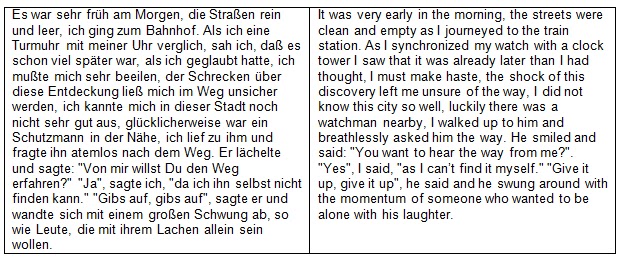
Give it up! Gibs auf! Desistir!

It's the title Max Brod give to a short, unpublished story of Frans Kafka (1883-1924). In the original papers of Kafka the title of this "story" was 'A Comment' (German 'Ein Kommentar').

The story in German (original) and English (translation):


Thursday, September 17, 2015

And You've Just Gotta

A lovely song I discovered yesterday:

"I don't want to wait anymore I'm tired of looking for answers
Take me some place where there's music and there's laughter
I don't know if I'm scared of dying but I'm scared of living too fast, too slow
Regret, remorse, hold on, oh no I've got to go
There’s no starting over, no new beginnings, time races on
And you've just gotta keep on keeping on
Gotta keep on going, looking straight out on the road"


Singer and song? Here.